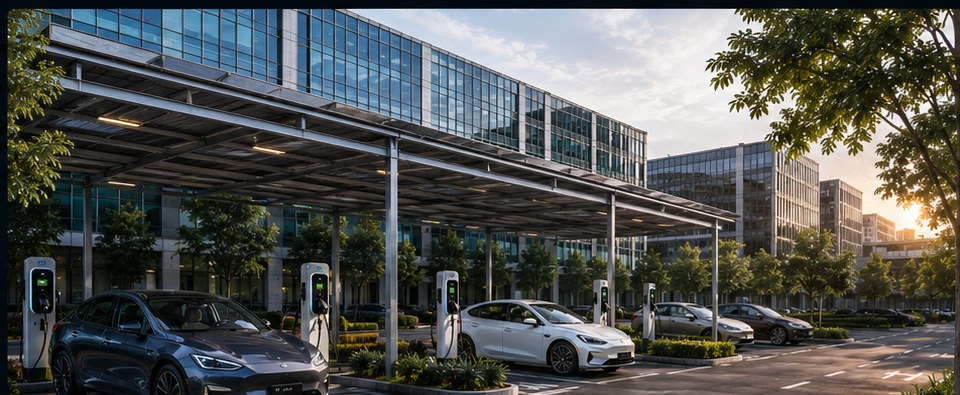
Workplace EV charging,
engineered as energy infrastructure.
7W Energy designs, deploys, and operates workplace EV charging for India's IT parks, commercial campuses, and premium real estate — AC charging, solar, storage and smart load management as one system. Starting with Hyderabad.
- Bay A-1282%6.6 kW
- Bay A-0864%7.2 kW
- Bay B-04100%0.0 kW
- Bay C-0138%7.4 kW
The conversation that fits where you sit.
Tell us which stakeholder you are — we'll route you to the right brief, the right CTA, and the right person within 48 hours.
I own or operate commercial real estate.
Workplace EV charging deployed and operated on your site. Revenue, ESG uplift, and tenant retention — without adding a capex line or ops burden.
- Revenue share · zero upfront
- Solar + storage integrated
- 8-week deployment model
I'm evaluating the workplace EV opportunity.
Pre-seed climate-infra stage. Hyderabad-first deployment model with anchor pilots, reference architecture, and a 5-year unit economics model.
- Pre-seed · Hyderabad-first
- Modelled 5-yr ROI · 4–5×
- Investor brief on request
I'm a charger OEM, EPC, or building partner.
Open architecture. OCPP 2.0.1 networked. We're actively onboarding charger OEMs, solar EPCs, battery and BMS partners for Phase-1 deployments.
- Open standards · OCPP 2.0.1
- Hyderabad Phase-1 onboarding
- Charger / solar / storage / BMS
EVs are accelerating. Workplace charging is missing.
India's EV transition is unfolding at the kerb. The highest-leverage charging window — the workplace — is structurally under-built. Commercial real estate is where the gap lives.
Cars sit 6–10 hrs at work
Workplaces are the longest, most predictable parking window in a driver's day — and the single highest-leverage charging opportunity that no one is building for.
Workplaces have no charging today
A vanishingly small share of Indian commercial campuses offer EV charging. EV-driving employees and tenants have nowhere to plug in during the hours they need it.
EVs are compounding rapidly
India is on a multi-million-unit EV trajectory this decade. The kerb-side and home-charging story is being told. The workplace story is essentially unwritten.
Buildings face new ESG rules
BRSR disclosures, IGBC and LEED certifications, and tenant ESG asks are forcing commercial real estate to retrofit EV infrastructure — or lose Grade-A standing.
The most concentrated workplace EV opportunity in India.
A dense IT corridor, predictable long-dwell parking, and one of India's most progressive EV policies — Hyderabad is purpose-built for workplace charging infrastructure.
Concentrated in a 12 km corridor from Madhapur to Financial District — the densest workplace footprint in India.
Long commute culture means longer dwell at work — and a real need for predictable, in-day charging access.
Mindspace, Cyber Towers, Knowledge City, Nanakramguda — all built around high-quality workplace amenities.
Telangana's EV policy and infrastructure incentives are amongst the most progressive in India.
Hyderabad's IT workforce parks for full working days — the structural condition for AC destination charging to outperform.
A defined, addressable set of premium IT parks, BFSI campuses, and luxury residential ecosystems in one city.

Three engagement models. One operating platform.
We work with owners and operators across structures — from zero-upfront revenue-share deployments to fully-funded managed services. The platform is the same. The economics are tuned to your stake.
Revenue share
7W deploys, operates, and maintains. Property owner provides the site. Per-kWh and parking revenue is shared on a contracted split.
- Zero capex for the property
- Shared per-kWh revenue
- Full operations by 7W
- Solar net-metering included
Managed deployment
The property funds the capex. 7W designs, deploys, and operates under a managed-services agreement. Higher long-term yield for the owner.
- Owner retains the asset
- 7W operates the platform
- Higher net yield
- Best-fit for Grade-A REITs
Platform subscription
For owners with existing chargers or in-house deployment. 7W brings the operations, analytics, ESG reporting, and load management layer.
- Per-station / month
- Networked + ESG console
- Works with multi-vendor fleets
- Faster, asset-light path
Pre-seed. Hyderabad-first. Pilot site discovery initiated.
An honest snapshot. No projection inflation, no soft-launched scale — the active workstreams under way and the partner posts we are filling.
- Hyderabad pilot site discoveryCommercial discussions initiated with target IT parks, BFSI campuses, and premium-residential counterparties.InitiatedPilot sites
- OEM & vendor ecosystem evaluationCharger, solar, storage and metering partners under evaluation. Commercial terms initiated with select providers.Under evaluationOEMs · EPCs
- MSME & statutory registrationsCompany, MSME, GST and operating-license filings under way.Under way—
- Deployment partner networkCivil, electrical and commissioning partners under qualification for Phase-1 deployment modelling.QualificationFM · EPC partners
- Founding engineering hiresDeployment lead, platform engineer, and field-ops manager — search initiated.Active searchEngineers · ops
- Seed & angel commercial discussionsInitiated with climate, infrastructure and green-finance investors.InitiatedInvestors
Four curves are bending at the same time.
EV adoption, ESG mandates, employee expectations and policy tailwinds — each individually meaningful, together a generational shift in how Indian commercial real estate has to behave.
India's EV mix is past the awareness phase. Volume growth — across two-wheelers and passenger cars — is now compounding, not speculating.
Top-1000 listed companies report BRSR. Tenant ESG asks now include workplace charging on the green-building checklist.
EV-driving employees rank workplace charging in their top-five workplace amenity requests. Tenants notice.
State EV policy provides clear incentives for workplace and commercial charging. The operating environment is favourable now.
Why employees actually charge at work.
"If employees can charge at home, why would they use workplace charging?" — the honest first question every property owner asks. Here is the structural answer.
Most Indian apartments are stilt + assigned + single-meter. Per-resident chargers are hard to retrofit at scale.
Hyderabad's IT corridor drivers cover 40+ km round-trip — real range pulled from the battery every day.
Car is already there, same spot, 8–9 hours. No detour, no queue, no decision.
Drivers need 20–40 kWh of dependable daily top-up — exactly what AC bays deliver.
No detours, no waits. Workplace AC is private to the campus — guaranteed access every working day.
Knowing the car will be charged by 6 PM is the single biggest unlock for daily EV usage.
Designed for buildings,
not highways.
DC fast-charging is highway infrastructure — short, high-power top-ups. Workplaces are the opposite: cars sit for 6–10 hours, predictably, every working day.
That's where destination AC wins — on capex, civil work, maintenance, solar pairing, and utilization. We build for that behaviour.
The unit economics aren't close.
A modelled comparison across the seven dimensions that decide payback. AC outperforms DC on every line that matters to a property owner.
- Per-bay capex~₹85k–₹1.2L~₹8L–₹25L~10× lower
- Civil & electrical upgradeMinimalHeavyPlug into existing infra
- Maintenance complexityLowHighLower opex
- Solar compatibilityNative fitConstrainedDesigned for solar
- Transformer burdenDistributedConcentratedNo upgrade needed
- Utilization predictabilityHigh & sustainedVariable / spikyBankable load curve
- ROI timeline (workplace)1.5–2 yr5–7 yr~3× faster payback
Modelled projections — based on Indian commercial tariffs, AC charger benchmarks, and rooftop solar yields. Site-specific outcomes vary; we re-model after every assessment.
Designed for long-dwell workplace charging.
Optimised for real office parking behaviour, energy efficiency, and infrastructure utilisation — not raw charging speed.
A fast charger is not a productive charger in an office.
A 50 kWh EV at 50% SOC needs ~25 kWh. A 22 kW charger delivers that in 1.2–1.5 hours — and then sits idle for the rest of the working day. The bay generates no further throughput.
- · ~25 kWh delivered
- · 1.5 hr active
- · 4.5 hr idle, occupied
- · ~25 kWh delivered
- · Across 6 hr
- · Solar-aligned
More slow bays beat fewer fast bays.
- Lower capex per bay
- Higher concurrent occupancy
- Better ROI on parking floor area
Power is distributed — not pushed.
When a vehicle needs 15 kWh by 6 PM, the system does not push maximum power on arrival. It distributes power across the day — informed by departure time, solar, and campus-wide load.
Same 25 kWh delivered. Half the peak load on the transformer. More solar consumed on-site.
Illustrative deployment economics.
- Year 1₹32 L₹18 L
- Year 2₹38 L₹23 L
- Year 3₹45 L₹28 L
- Year 4₹52 L₹33 L
- Year 5₹60 L₹38 L
Illustrative projection. Site-specific outcomes re-modelled after every assessment.
Built for efficient workplace energy utilisation.
Designed around real workplace parking behaviour, intelligent energy allocation, and long-duration charging patterns.
Solar reduces cost. Grid keeps the network running.
Solar offsets daytime demand. Storage smooths the curve. The grid is the always-on fallback.
Solar is cost optimisation, not off-grid charging.
The numbers behind the thesis.
Higher capex than the AC-only anchor pilot shown above — but solar pulls down the operating cost curve, and the 5-year compounding outperforms.
Hyderabad IT park · 100 kW solar.
Hyderabad IT park · 100 kW solar · smart AC charging. Illustrative; site-specific outcomes re-modelled after assessment.
Designed around how each property actually parks.
Six segments. Different parking behaviour, different tenant profile, different deployment opportunity. The engagement model adapts.
IT Parks & SEZs
Grade-A Offices
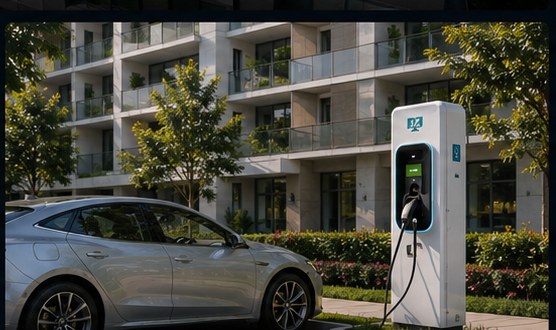 Residential
Premium Apartments
Coworking & Flex
Mixed-use Campuses
CRE Operators & REITs
AC charging, solar, storage — run as one system.
7W is not a charger vendor. We design, deploy, and operate workplace charging — chargers, solar, storage, and load management — on one site console.
Smart AC charging
OCPP-2.0.1 networked AC stations sized for 8-hour workplace dwell — 3.3 to 22 kW per bay, future-proofed across passenger EV models.
Solar & storage integration
Rooftop solar engineered to peak with charging load. Optional LFP storage for tariff arbitrage and demand-response participation.
Smart load management
Dynamic kW allocation across stations, breakers, and the building's existing transformer. No infrastructure upgrade. No tripped mains.
Operations & analytics
Site console for FM teams, RWAs and ESG officers — utilization, uptime, charging revenue, CO₂ avoided, BRSR-ready exports.
Scalable deployment model
Modular architecture — start with 6 bays, scale to 600 across a campus. Every site joins the same operating platform from day one.
Solar, storage, charging — engineered as one system.
Software is the wedge — the asset is physical. Rooftop solar, optional battery storage, networked AC chargers, smart metering, and the building's electrical backbone — commissioned and operated as one system.
Illustrative campus schematic. Site-specific deployments vary by load, roof, parking topology and tenant mix.
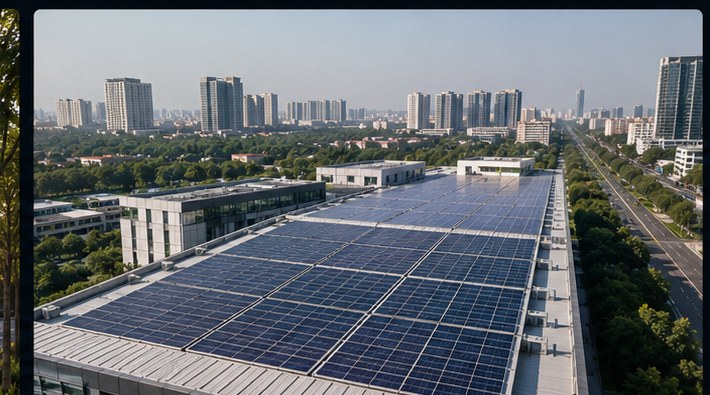
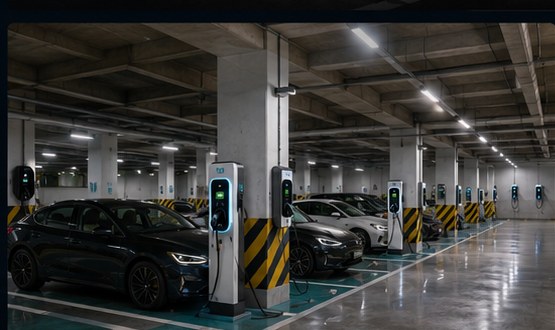
The infrastructure is physical. So is the work.
From office campus deployments to rooftop solar and covered-parking charging — the operational picture across a workplace charging network.
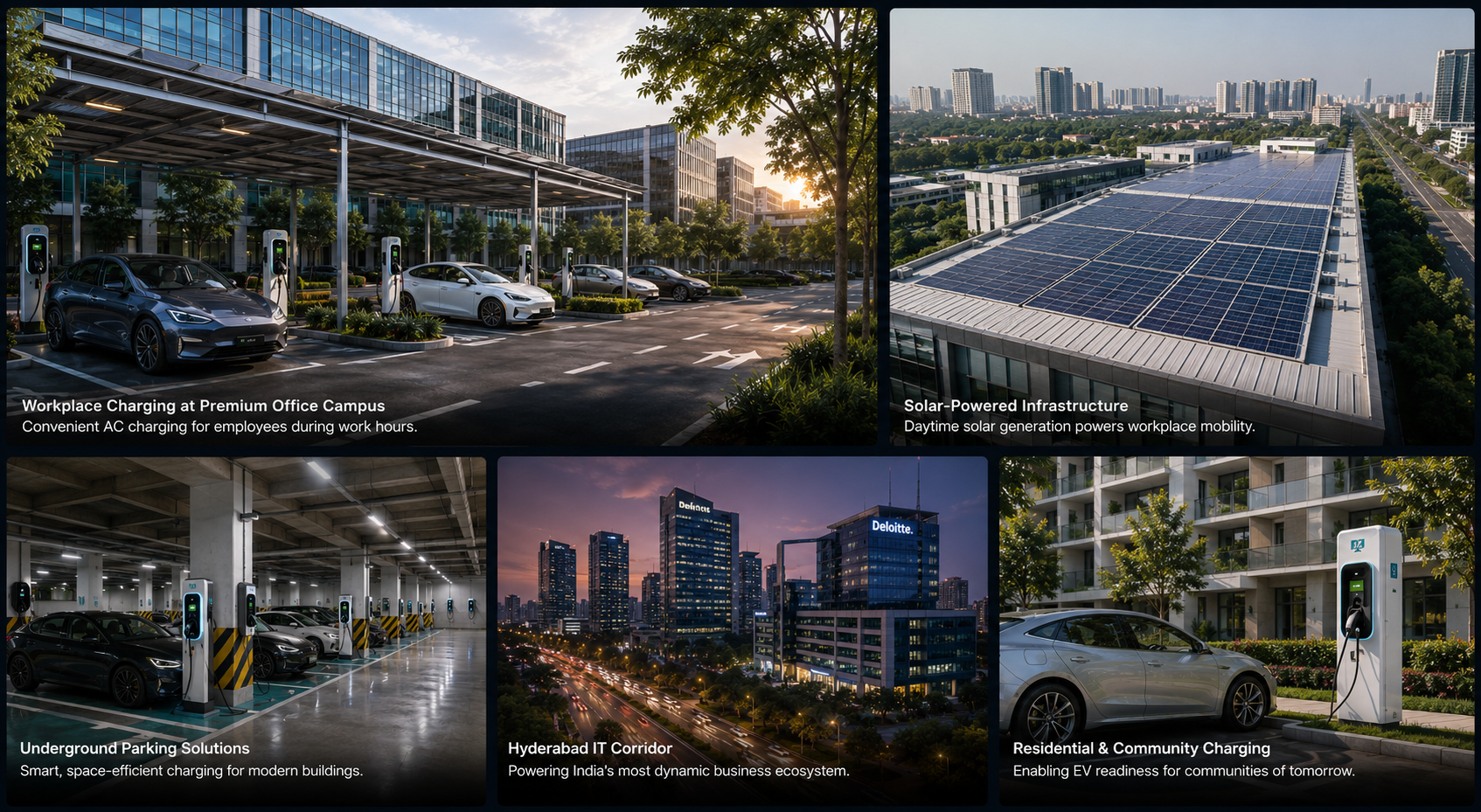
- Workplace charging at office campus
- Rooftop solar for daytime charging
- EV charging inside commercial parking
- Smart, reliable & safe infrastructure
- Sustainable workplace experience
- Scalable infrastructure for growing fleets
- Hyderabad — India's leading IT & business corridor
A worked example for a Hyderabad IT park.
Solar canopy, AC chargers, distribution, transformer interface, and load management — commissioned together and operated as one system.
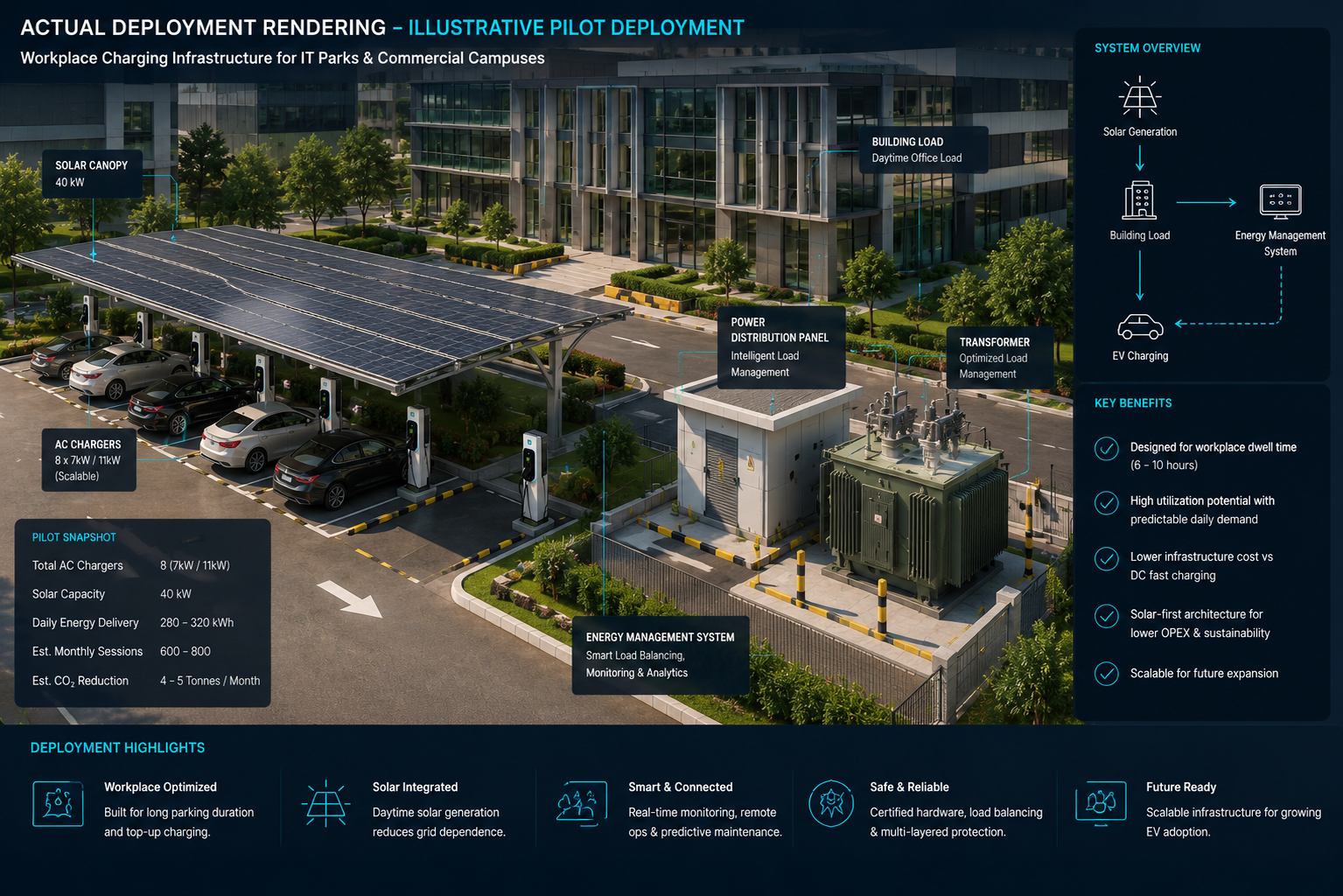
Illustrative simulation. Site-specific outcomes re-modelled after every assessment.
Full Phase-1 deployment, modelled end to end.
A larger pilot scenario — 24 stations, full rooftop solar, optional storage. Numbers are projections, refined site-by-site after assessment.
Grade-A IT park · ~12M sq.ft. tenant footprint
Modelled monthly outcomes
Four documents that cover the entire deployment picture.
Pilot Deployment Overview
How the 8-week deployment works, with an illustrative pilot snapshot.
Property Owner Deck
Revenue, ESG, retention — what workplace charging means for the owner.
Deployment Model
Reference architecture — chargers, solar, storage, load management, ops.
Workplace Charging Thesis
Why AC destination charging is the right wedge for Indian commercial RE.
Documents updated quarterly. Email info@7wenergy.com for the latest versions.
From site walk to live network in ~8 weeks.
A single-vendor model. We handle engineering, permits, civil work, commissioning, and ongoing operations. Your FM team stays focused on the building.
- 01
Site assessment
Week 1Engineers walk the site, audit electrical capacity and vehicle flow, profile tenants. We model expected utilization and energy demand by hour.
01 - 02
Infrastructure design
Week 2–3Single-line diagrams, load schedules, civil drawings, and a phased rollout plan — sized for today's traffic and tomorrow's growth.
02 - 03
Charger deployment
Week 4–6Networked AC chargers commissioned, tested, brought online. Minimal disruption to operations. RFID/UPI access from day one.
03 - 04
Solar & storage
Week 6–10Rooftop solar engineered to peak with charging demand. Optional battery storage. Net-metering filings handled end-to-end.
04 - 05
Operate & monitor
Ongoing24×7 monitoring, predictive maintenance, demand-response, and quarterly ESG reports — from the 7W site console.
05
Engineered for uptime from day one.
Every site is commissioned to commercial-grade specifications and operated against measurable SLAs.
After commissioning is when the work actually starts.
Every site runs against a written support stack — uptime SLAs, monitoring, AMC, and field response — operated by 7W from day one.
Uptime SLA
Station uptime backed by a written SLA. Targets and penalties part of the contract — not the sales pitch.
24×7 monitoring
Live charger health, energy, and communication telemetry from the site gateway. Watched continuously.
Remote diagnostics
Fault isolation and software-level fix without a truck roll. Most issues closed inside the platform.
Preventive maintenance
Quarterly inspections, calibration, and firmware updates — scheduled around tenant operations.
AMC & spares
Annual maintenance contract with spares logistics. First-call resolution targets, with stocked critical inventory.
Field response
On-site engineer within a contracted response window via the FM partner network. In-city same-day, out-of-city next-day.
Built on standards. Plugged into the partners who matter.
7W is an open-architecture platform. We don't lock you into a single charger, OEM, or utility. Instead, we orchestrate the best-in-class ecosystem already serving Indian commercial infrastructure.
Standards-based networking. Multi-vendor charger compatibility from day one.
Hardware partners across AC and DC, tier-1 to Indian-manufactured.
Rooftop solar design, supply and commissioning partners across Telangana & AP.
LFP cell supply, BMS, and behind-the-meter storage integration partners.
ABT-grade meters, gateway integration, and per-bay sub-metering.
UPI, RFID, corporate billing, and tenant-portable wallet integrations.
BMS, FM platform, and access-control integrations for Grade-A properties.
Utility APIs, demand-response programs, and ESG reporting integrations.
Built into the BRSR + green-building reporting stack.
Workplace EV charging is now an ESG datapoint, not a parking amenity. Every site we deploy produces audit-ready disclosures and contributes to recognised certifications and incentives.
BRSR-ready Scope-2 exports
Per-tenant electricity consumption, charging revenue and CO₂-avoided data exported in formats aligned with SEBI BRSR disclosure requirements.
LEED v4.1 + IGBC credit support
Workplace charging contributes to LEED EAc Green Vehicles (up to 12 points) and IGBC Green New Buildings credits. Documentation handed over with the deployment.
Auditable CO₂-avoided ledger
Per-site, per-month CO₂-avoided figures benchmarked against the Indian grid emission factor. Auditable from the site console.
GRI 305 + GHG protocol aligned
Site emissions data structured around GHG Protocol Scope-2 location-based and market-based methodologies, ready for GRI 305 disclosures.
Aligned with Telangana EV policy
Deployments structured to qualify for state EV policy incentives. Net-metering filings handled in-house. State and central scheme alignment tracked per site.
IEC 61851 + AIS-138 / BIS compliant
Hardware specifications and commissioning aligned with IEC 61851 (EV conductive charging), AIS-138 (Indian AC charging) and applicable BIS standards.
Charging is the wedge. Workplace energy is the long game.
Every workplace bay we deploy is a sensor. Every kWh routed is a signal. The compounding asset is the operating platform underneath.
- Phase 1 · 2026In progress
Hyderabad pilot deployments
Anchor pilots across Hyderabad's IT parks, commercial campuses, and premium residential ecosystems. Prove unit economics.
- Phase 2 · 2027Planned
Cluster deployments
Scale across IT-park clusters. Standardize the deployment playbook. First multi-site managed-services contracts.
- Phase 3 · 2028Planned
Workplace charging network
Connect deployments into a single roaming-capable, network-of-networks. Tenant-portable charging accounts.
- Phase 4 · 2029Planned
Smart energy management
Predictive load shifting, dynamic tariffs, V2G arbitrage, demand-response. Every site becomes an active grid participant.
- Phase 5 · 2030+Direction
Adjacent expansion
Extending the workplace charging platform into adjacent commercial segments — retail, mixed-use, and industrial — once the core is operating at scale.
Where India's tech workforce parks every day.
Our target deployment ecosystems span Hyderabad's densest commercial corridor. None are operational yet — these are the Phase-1 conversations we are actively pursuing.
Mindspace · Madhapur
Hitec City · Cyber Towers
Financial District · Nanakramguda
Premium residential ecosystems
The thesis, the market, and where the capital goes.
Pre-seed climate-infra. Hyderabad-first. A long-duration asset class hidden inside the most operationally serious counterparties in India: Grade-A commercial real estate.
The window is opening now.
Pre-seed → Seed → Series A.
- Pre-seed · nowOpen
Pilot capital
Fund 3–5 Hyderabad anchor pilots, founding engineering hires, and operating runway through 12 months of pilot validation.
- Seed · 2027Planned
Cluster deployment
Scale from anchor pilots to clustered IT-park rollouts. First multi-site managed-services contracts, expanded ops team.
- Series A · 2028+Planned
Network expansion
Convert deployments into a roaming-capable workplace charging network. Expand beyond Hyderabad along the South-India corridor.
Where the capital goes.
- 45%Pilot deployments + capex
- 25%Engineering + platform
- 15%Field operations + commissioning
- 10%GTM + partnerships
- 5%Reserve + compliance
Indicative allocation. Final ratios refined with lead investor.
Operating principles for an infrastructure company.
Infrastructure, not installations
We build a long-duration asset class. Every choice — from charger specs to platform architecture — is made on a 10-year horizon.
Software-first, hardware-grade
Our edge is the operations and data layer. Every charger is a node on the network — not a standalone box.
Owners are partners
Aligned incentives. Transparent revenue share. No lock-in. The buildings we electrify outperform — that's the only flywheel that compounds.
Operational discipline first
Uptime, utilization, deployment efficiency, and recurring infrastructure revenue. We optimize for execution metrics, not vanity numbers.
Pick the conversation you'd like to have with us.
Different stakeholders, different conversations. Tell us which one you are — we'll route you to the right person within 48 hours.
Property / asset owner
You own or operate Grade-A real estate. You want recurring revenue, ESG uplift, and zero ops burden.
RWA / residential committee
You represent a premium gated society or apartment ecosystem. You want EV infrastructure your residents will actually use.
Enterprise / occupier
You're a corporate occupier or facility partner. You want EV charging deployed for your tenants, employees, or fleet.
Investor
You're a climate, infrastructure, or seed investor evaluating the workplace EV opportunity. Let's share the deck.
- 01Week 1Site assessment45-min walkthrough. Electrical capacity, parking layout, tenant profile.
- 02Week 2Load analysisHourly utilization + demand model. Solar + storage sizing.
- 03Week 3Deployment proposalEngagement model, phasing, ROI, BoQ — in one document.
- 04Week 4–6Installation & commissioningCivil, electrical, charger commissioning, network testing.
- 05OngoingOperations & monitoring24×7 monitoring, predictive maintenance, ESG reporting.